Executive Summary
In January, February and March, UK Heritage Pulse is undertaking The Big Think – a sector-wide conversation shaped around three critical questions, one each month. This Big Think is centred around Place.
This three-part series aims to:
- Understand how heritage organisations currently engage with place, and their ambitions
- Map the practical relationships and challenges in place-based work
- Identify what support would strengthen heritage’s contribution to community cohesion and resilience
For the purposes of this research, ‘place’ refers to a meaningful location, and definitions vary depending on where you are and who you ask. It could mean:
- a local community,
- a natural landscape, or
- an entire city
Survey Report (The Big Think)
In March our objective was to understand what’s changing, what support is needed, and where heritage can make the biggest difference to community resilience.
We received 91 responses to at least one question about Place, or the monthly Pulse Monitor questions, which track the individual and organisational resilience of respondents.
This is an interim report. Panel members who did not complete this survey will have the opportunity to answer these questions again. After reopening previous surveys this month, we received an additional 56 responses for January’s edition and 7 more responses to February’s questionnaire.
Key findings from the research exploring Place
- 74% of respondents believe they are responding well to the pressures they face in their place.
- 69% of respondents cite lack of funding as their greatest pressure. More than half find the physical condition of their heritage and the impact of the cost of living on their communities challenging.
- More than three in four respondents say that long-term, flexible funding would strengthen the role of heritage in their place over the next five years.
Pulse Monitor
Taking the pulse of the people who care for our shared heritage. This month’s scores sit broadly in line with those seen over recent months:
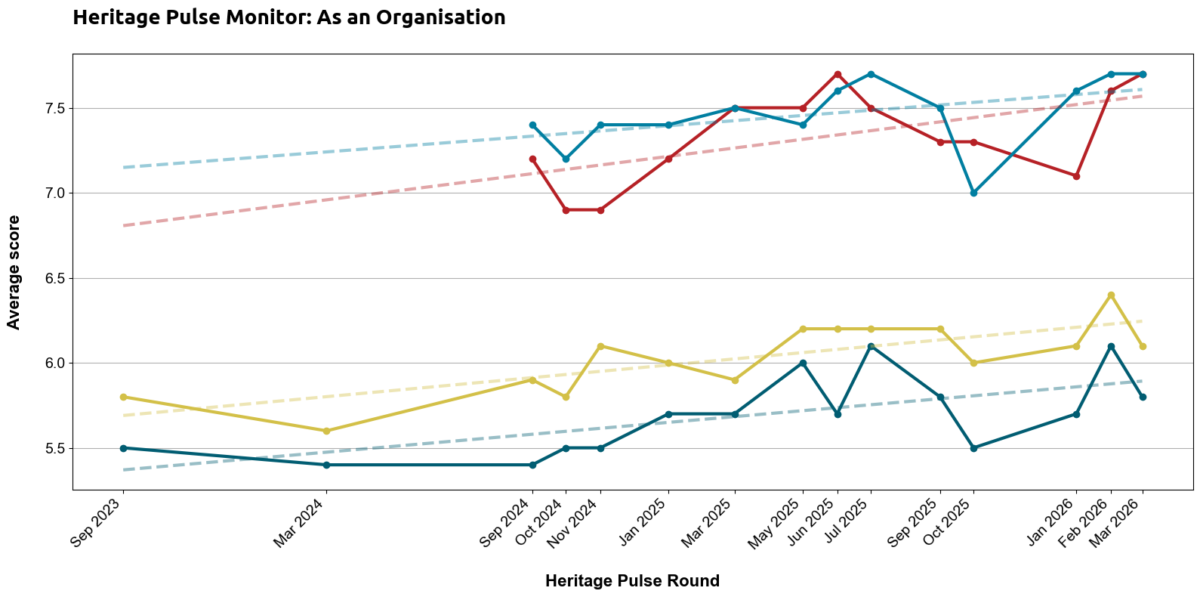
- Recruiting and training volunteers/staff (5.8/10) and adapting to reduce income or increasing costs (6.1/10) remain the lowest scoring measures, consistent with the pattern seen through the past year.
- Confidence in adequately caring for heritage/collections softened this period, but stays within the range overserved over the past year.
- Belief that organisations will survive the coming 12 months (7.7/10) and clarity around objectives remain stable.
The Big Think: Place
Three-quarters of respondents say they are responding well to pressures affecting heritage in their place
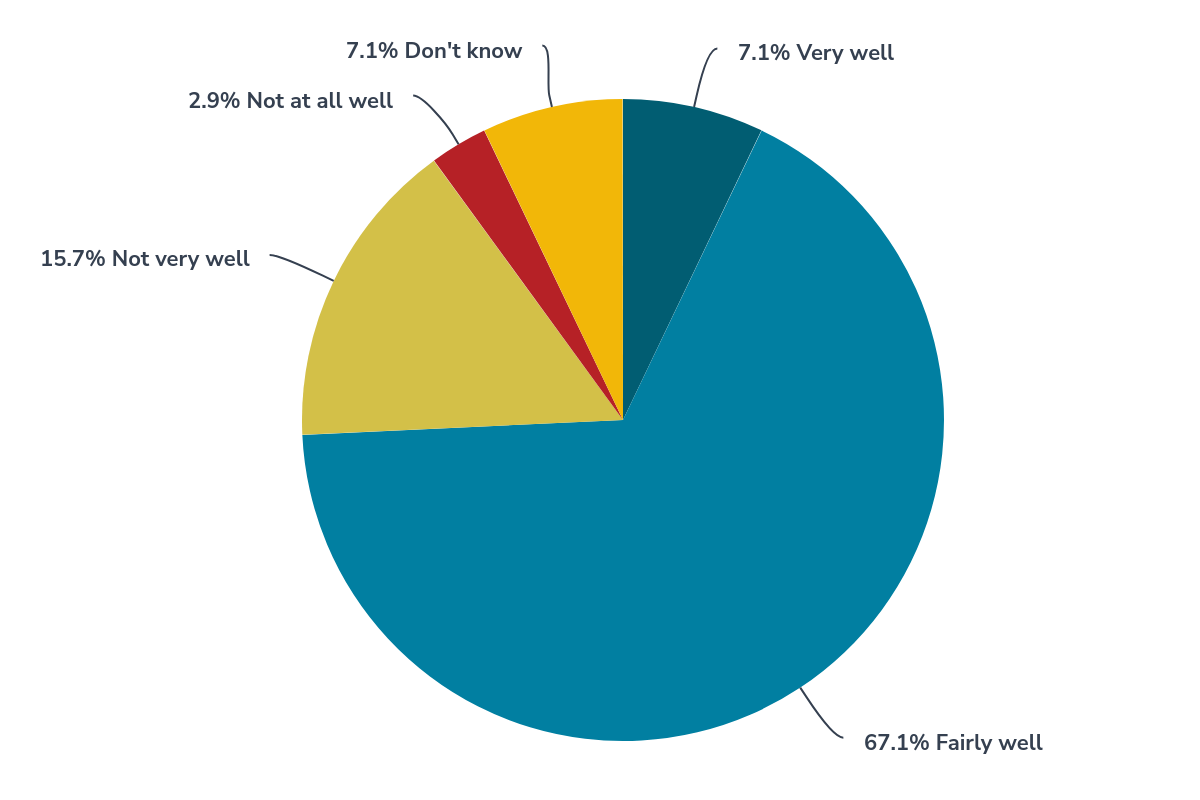
How well is your organisation responding to these pressures?
n=70
While the panel report that they are facing challenges in their work, 74% say they are handling this well. There is a similar trend when segmenting by turnover and number of paid employees.
More than two-thirds say lack of funding is the greatest pressure affecting heritage in their place
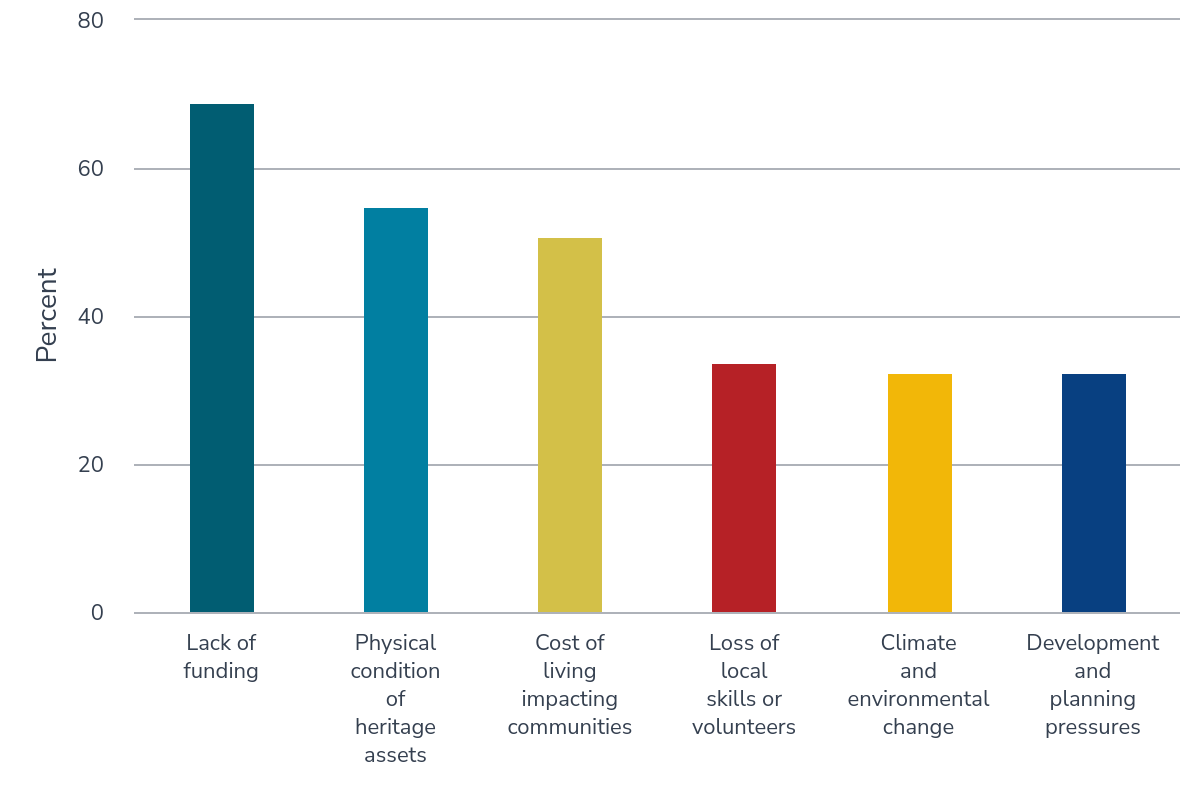
Which pressures are currently affecting heritage in your place most?
n=71
69% of respondents selected lack of funding as the greatest pressure affecting heritage in their place, followed by the physical condition of heritage (55%) and the impact of cost of living on communities (51%).
Organisations with a turnover of less than £1 million also identify lack of funding as their greatest pressure, but said that the impact of the cost of living on their communities is a greater pressure than the physical condition of heritage assets.
75% of respondents say that long-term, flexible funding would strengthen the role of heritage in their place
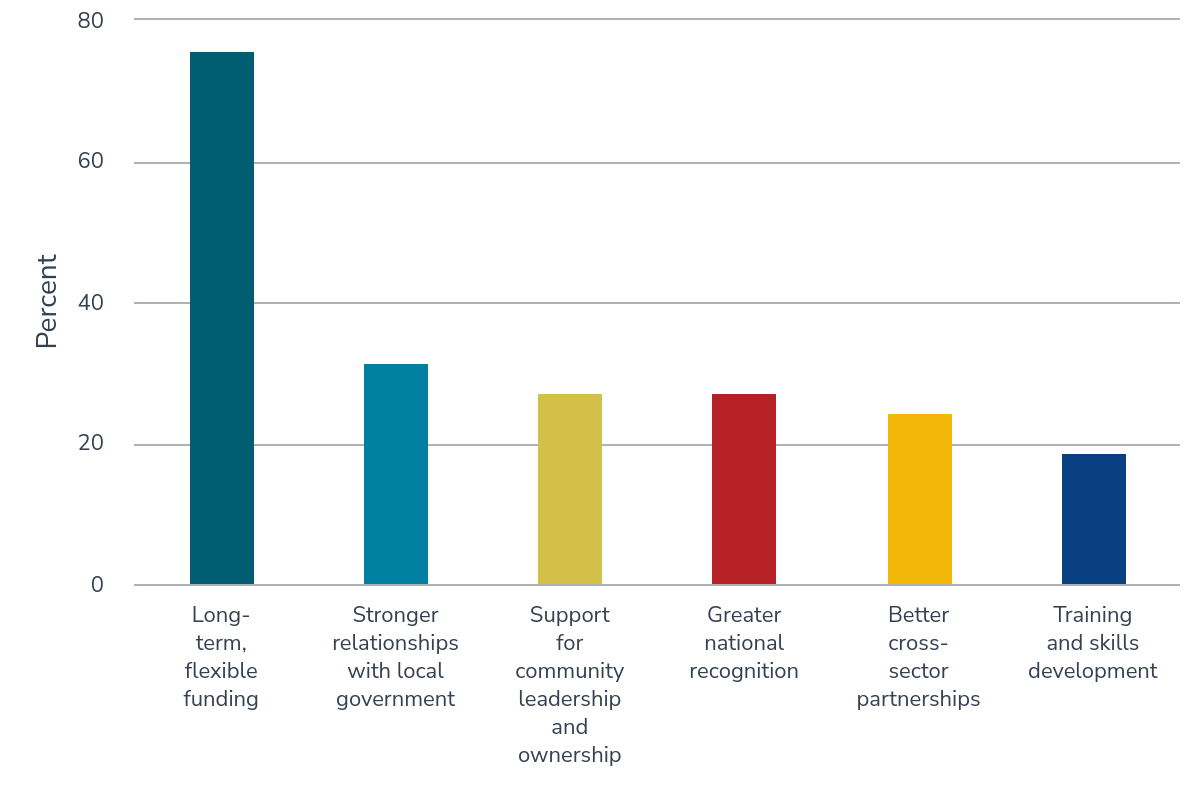
What would most help strengthen heritage’s role in your place over the next 5 years?
n=70
In February, we found that heritage organisations were prioritising relationships within their community, local government and heritage organisations. While 31% of respondents believe stronger relationships with local government would most help strengthen the role of heritage in their place over the next five years, more than twice as many identified secure and responsive funding as the key intervention.
Support for long-term, flexible funding increases to 83% when segmenting for organisations with at least one paid employee.
Heritage supports a range of activities that increase community cohesion and resilience
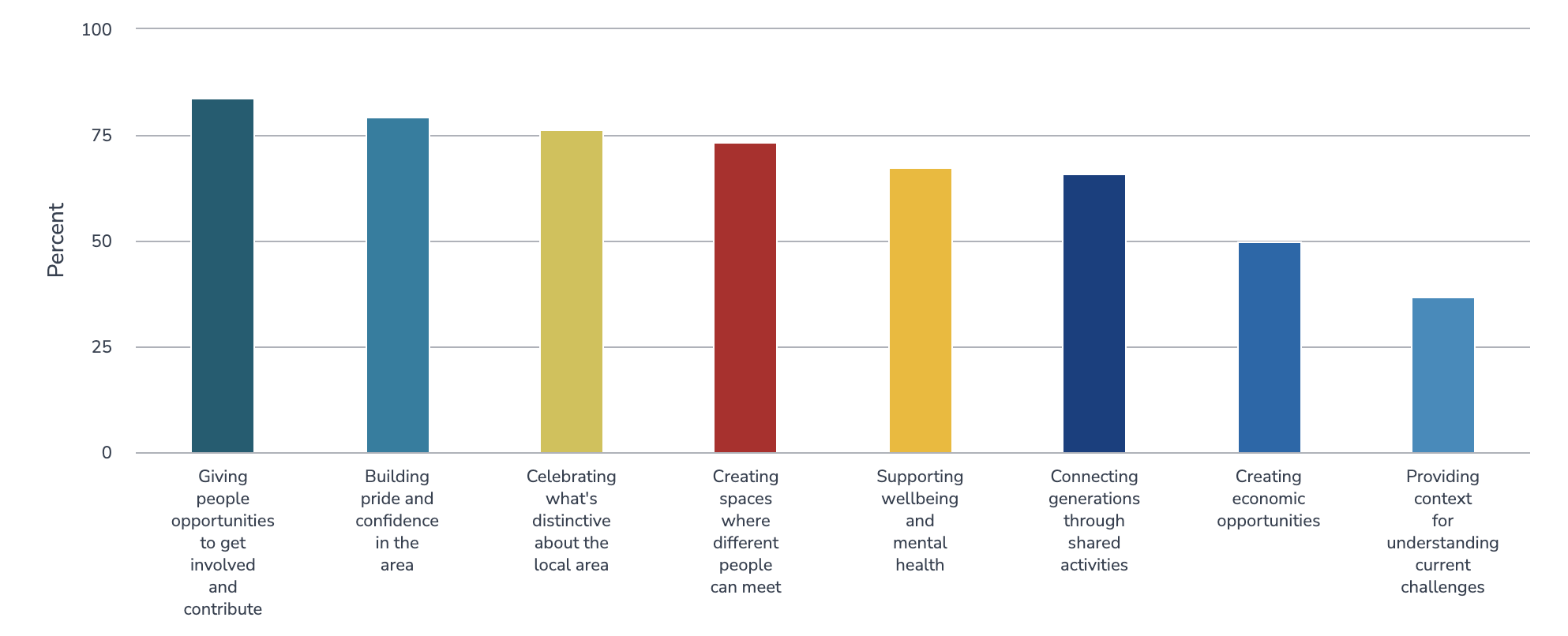
Thinking about community cohesion and resilience: which of these contributions can heritage realistically make in your place?
n=68
The panel believes that heritage can contribute to a range of social activities in their place to boost community cohesion, such as creating opportunities for residents and visitors and building pride in the area. This focus on local, community-based work echoes February’s survey, which revealed community groups were the largest users of panel members’ heritage.
Only half of respondents believe that heritage can realistically contribute to economic development in their place, and 37% think that heritage has a broader social role, providing context for wider challenges.
Measures to boost capacity would help heritage contribute more to their place
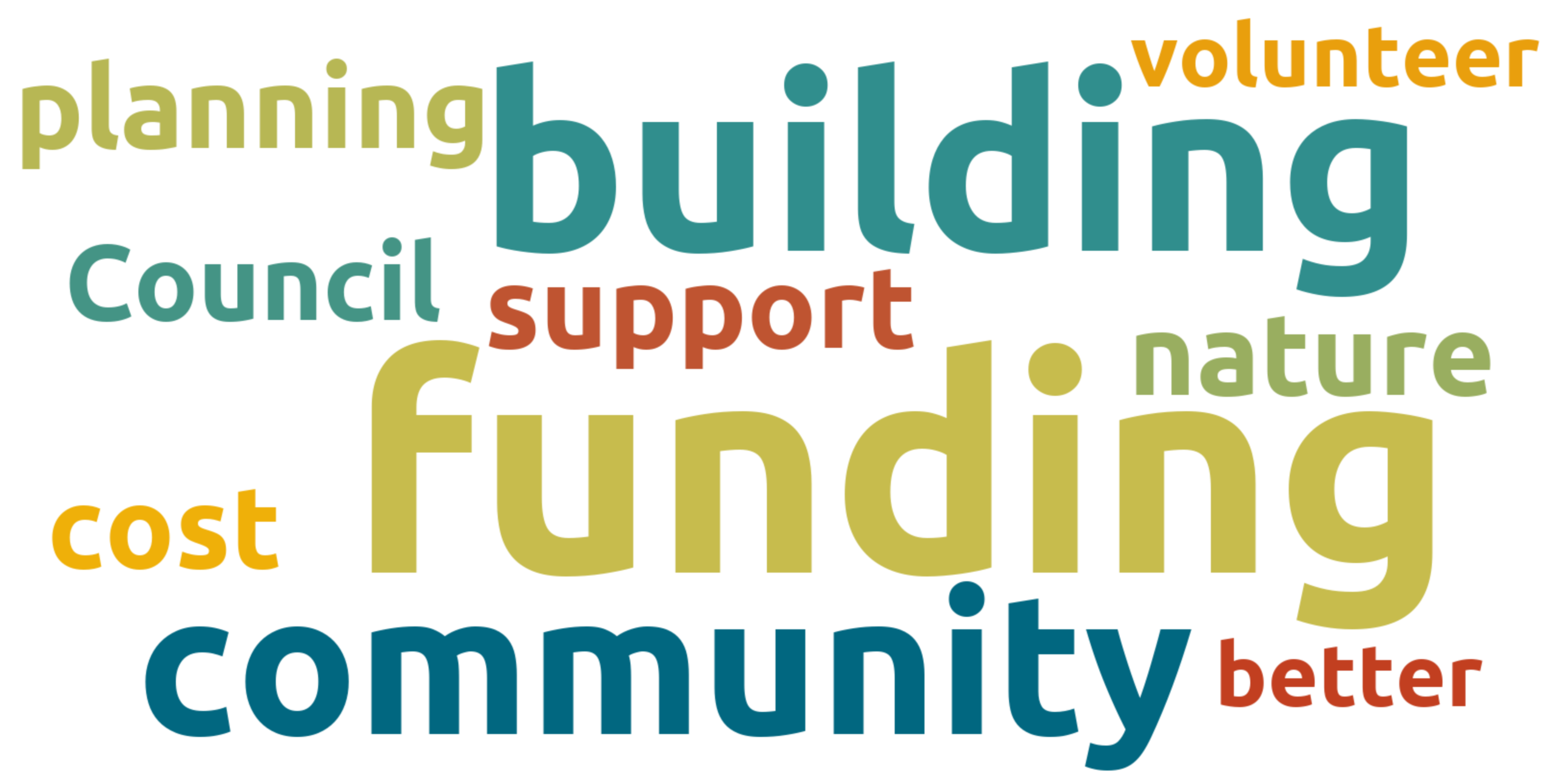
If you could make one practical change that would help heritage contribute more to your place’s future, what would it be?
n=60
We asked respondents to identify one practical change through a free-text qualitative question. In response, panel members feel that they are doing valuable work but lack the money, staff, and institutional support to do it sustainably.
Funding is the dominant concern and mentioned in many forms, through changes to financial burdens, grants and more general wishes for the benefits that come from sustainable funding:
UK Government to change the law so that all repairs to listed buildings over £1,000 per invoice are zero-rated.
Reverse reductions to LPWS budget conditions which are now being carried forward to new Places of Worship scheme.
Access to longer-term funding would give us the opportunity to plan, rather than react.
Pulse Monitor
Pulse Monitor is a monthly health check on the heritage sector, measuring its resilience, confidence and ambition.
This month had fewer respondents to Pulse Monitor (n=73) than in January and February, meaning outliers are more likely to make an outsize difference to the average scores. The month-on-month movements noted below should be read with that caveat in mind; the underlying trend lines (dotted) remain the more reliable guide.
Panel confidence trends hold steady across practical organisational challenges
73 panel members completed this question
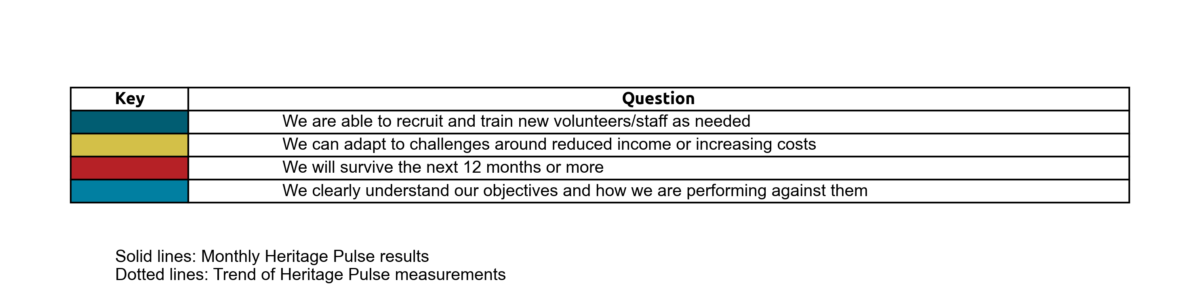
Scores across all four measures have held in a narrow band over recent months. Understanding of objectives and belief in surviving the next 12 months continue to sit at the top end of the range, while confidence in recruiting staff and adapting to costs remains the more pressured area, as it has been throughout the past year.
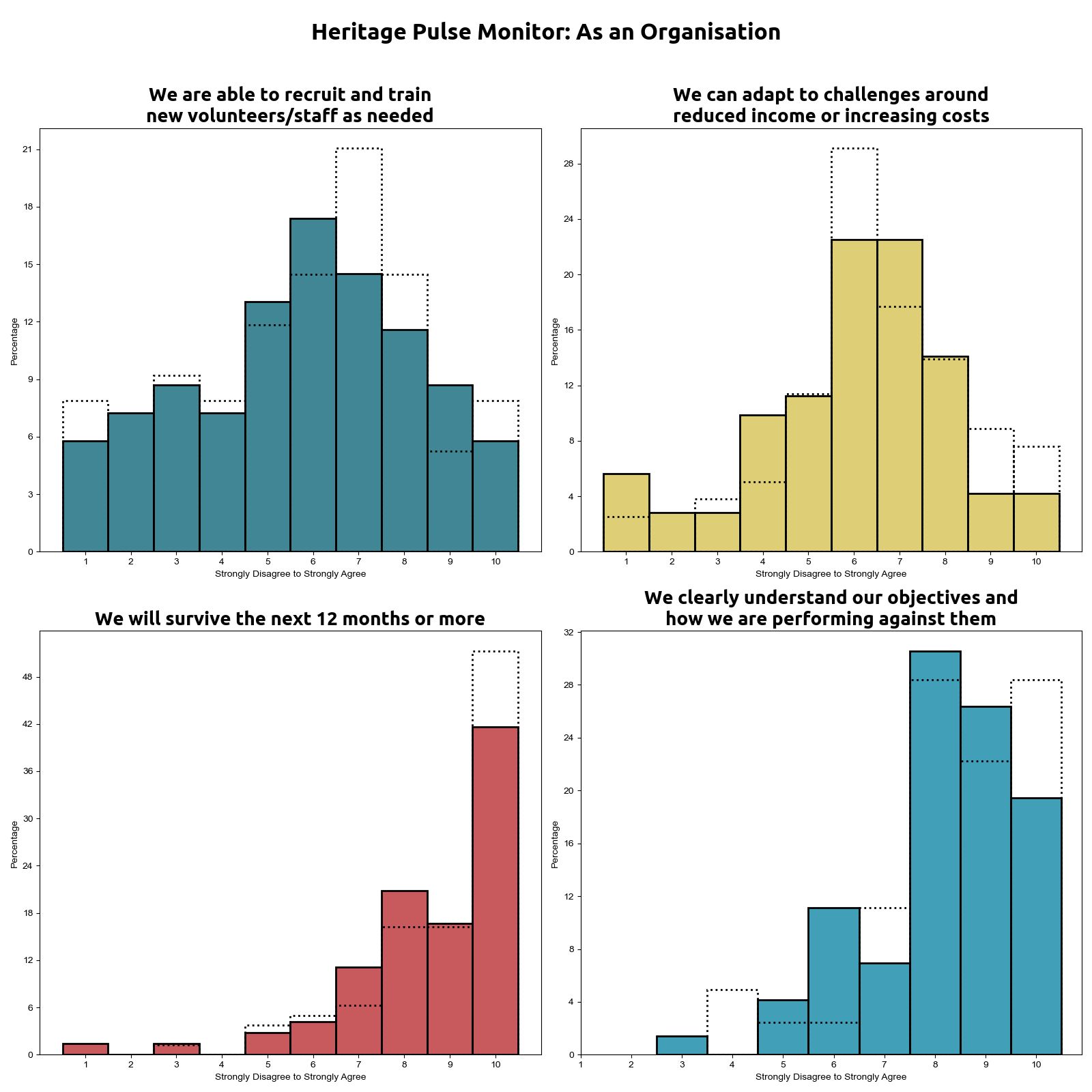
Solid bars: March 2026 response distribution / Dotted bars: February 2026 response distribution
When asked about their survival prospects, and how they were performing against their objectives, there was a narrow spread of responses amongst the panel, with answers to both questions clustered in the 8-10 / 10 range.
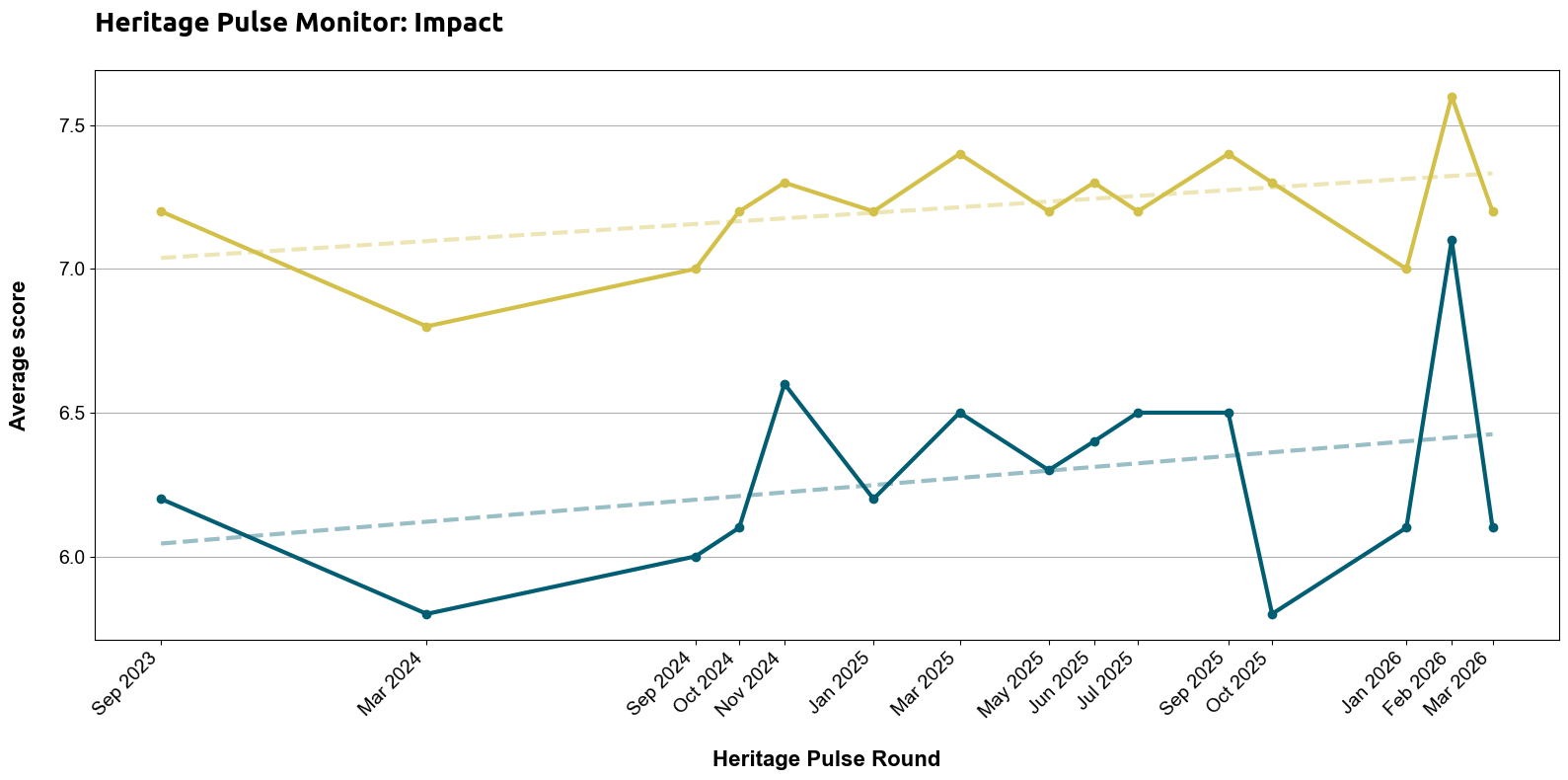
Impact measures settle back after February’s uptick
72 panel members completed this question.
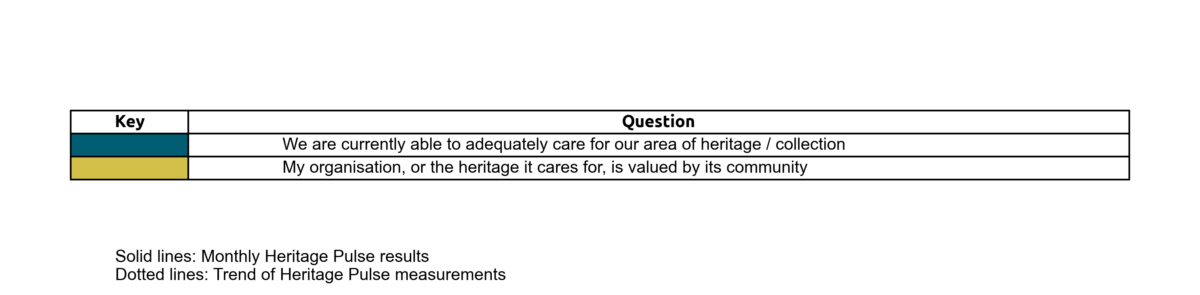
Both impact measures eased this month “We are currently able to adequately care for our area of heritage/collection” and “My organisation, or the heritage it cares for, is valued by its community” sit within the range observed over the past year, with February now looking like a high point rather than a new baseline.
February’s scores may have been lifted by seasonal factors such as the school half-term, with March returning close to where these measures have sat across the past year. Together with the smaller sample this month, that suggests that February peak – not March’s decline – is potentially the outlier.
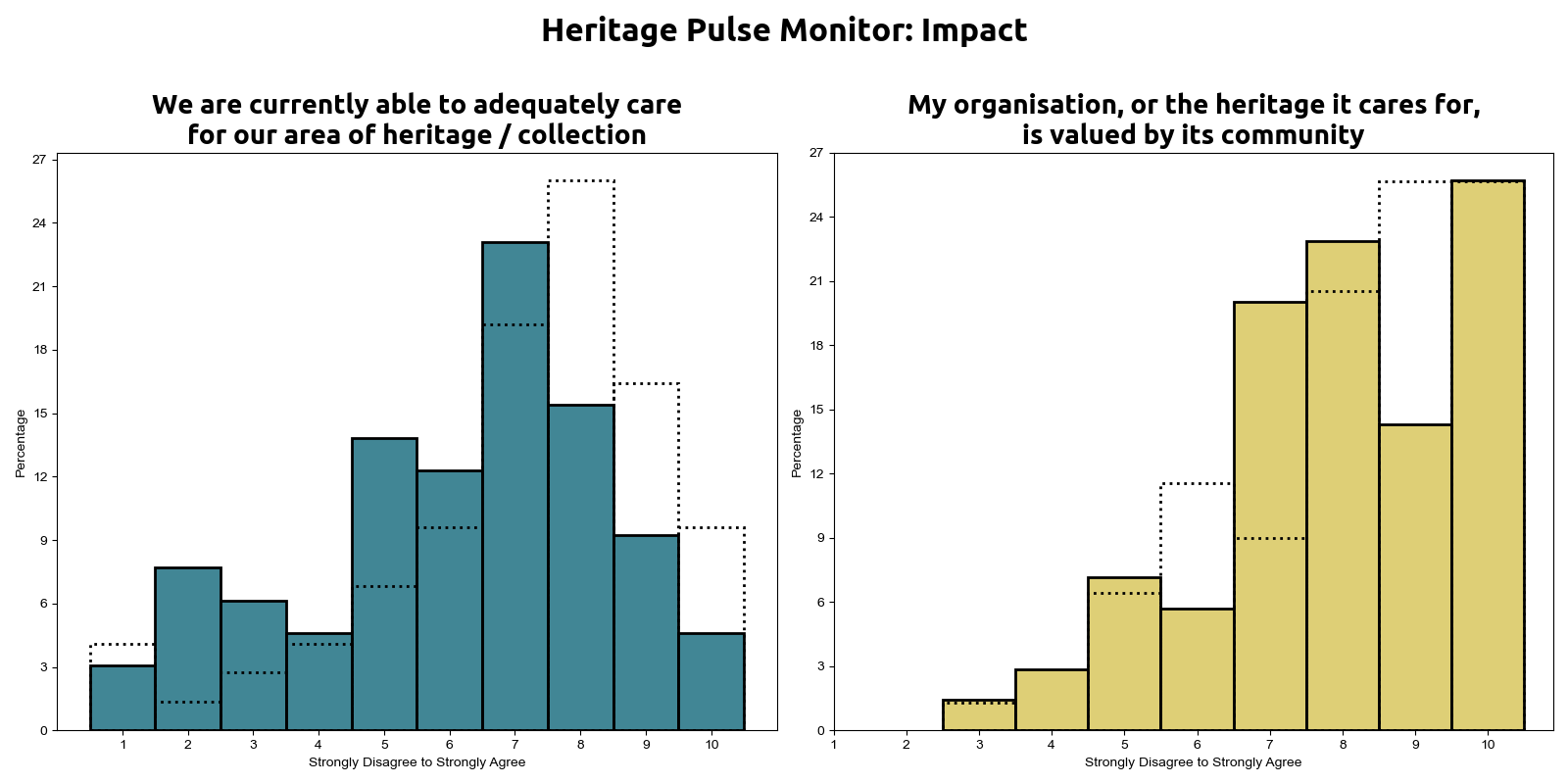
Solid bars: March 2026 response distribution / Dotted bars: February 2026 response distribution
Looking at the capacity to care for heritage, there was moderate disagreement amongst the panel, with responses shifting away from 8-10 / 10 this month to lower scores.
Personal impact of heritage work lReported stress levels and intention to remain continue a narrowing trendessens this month
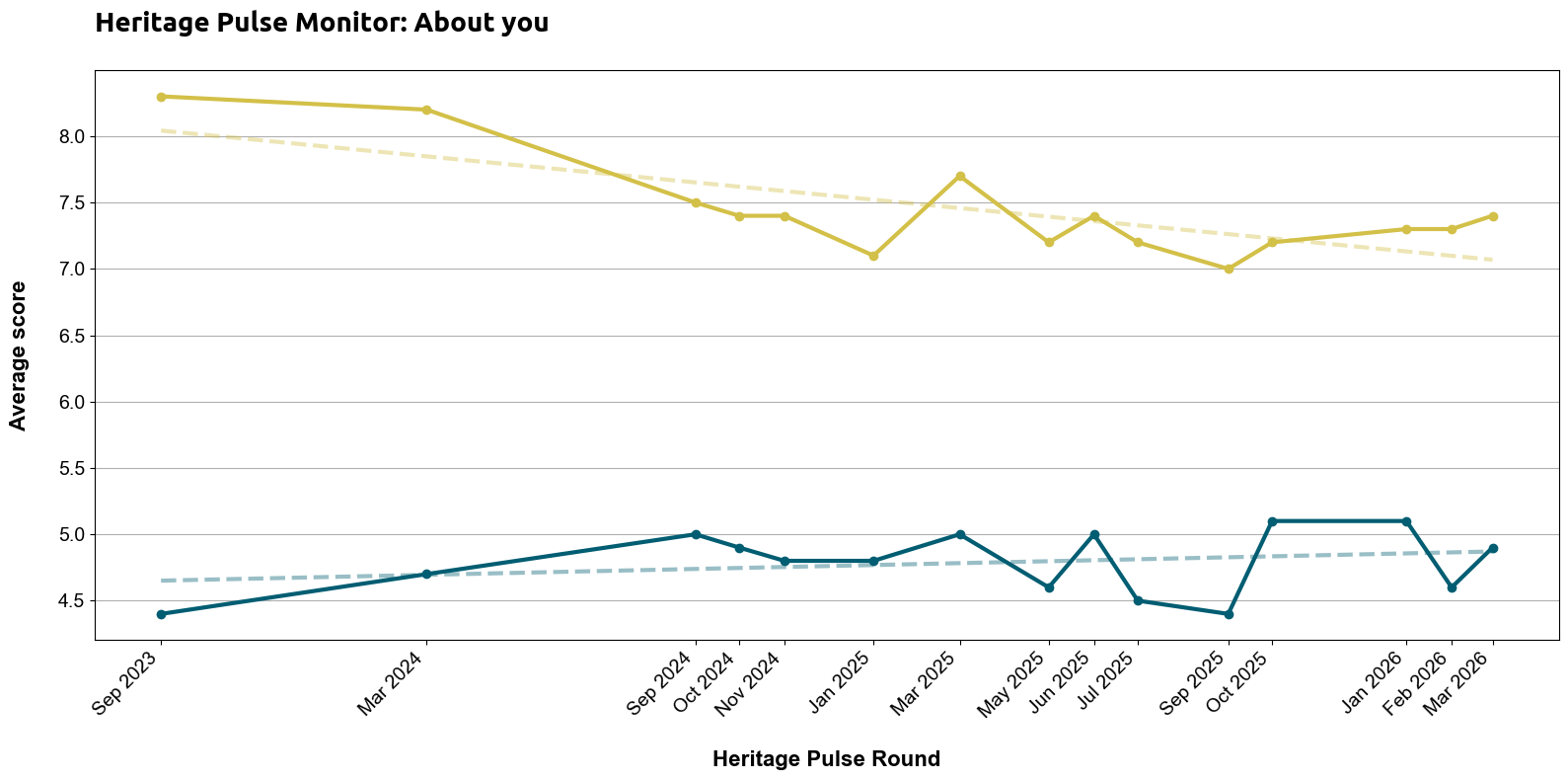
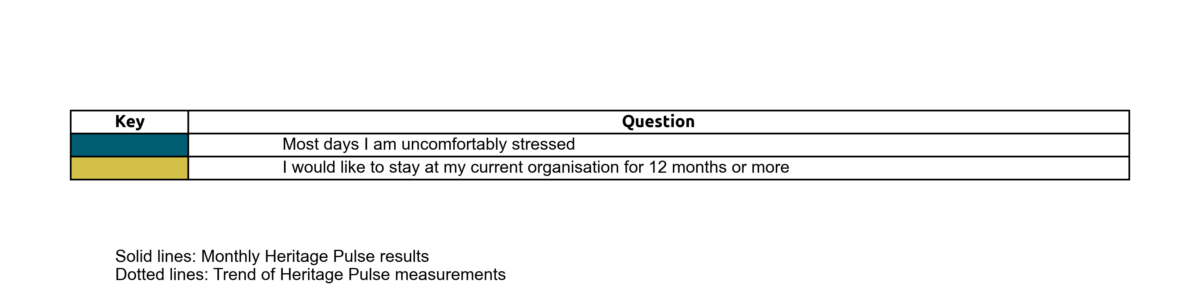
72 panel members completed this question
In September 2023, the two measures were nearly 4 points apart; that gap has now narrowed to around 2.5 points. If these two trends converge further, it could point to increased risk of staff turnover in the sector.
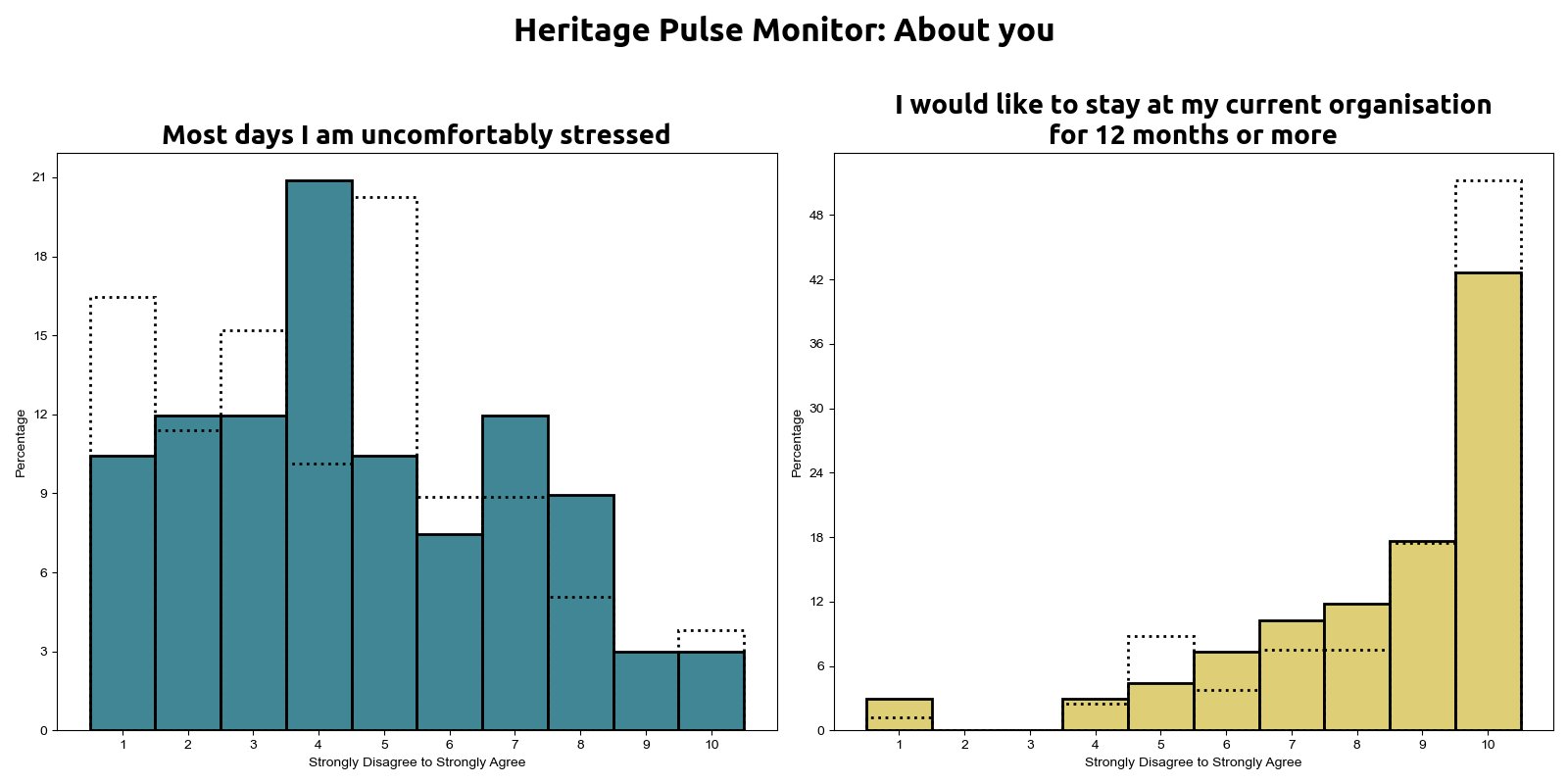
February Solid bars: March 2026 response distribution / Dotted bars: February 2026 response distribution
“Most days I am uncomfortably stressed” had a wide distribution of responses in this survey, showing that the mean score of 4.9 / 10 is not universally shared throughout the sector.
How representative of the Heritage Pulse panel were the March 2026 respondents?
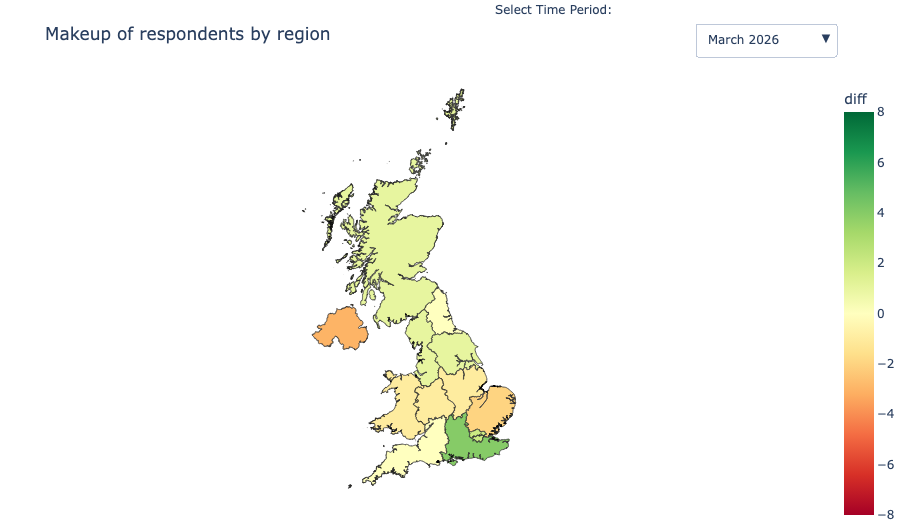
Compared to the entire panel, the South East (+4 points) was the most overrepresented region in this survey. By contrast, Northern Ireland was the most underrepresented region, three points lower than its panel average.
ENDS