Commercial activity supports a substantial share of the heritage work represented in our September UK Heritage Pulse survey. Most respondents see a place for entrepreneurial thinking in the sector, and almost two-thirds of those answering about their plans expect to grow an existing activity or start something new over the next year. Their comments describe the practical difficulties of finding time to develop a business alongside caring for heritage.
The main findings are:
- 89% lean towards the view that the sector must embrace entrepreneurial thinking to survive.
- 63% of those answering the question say their trading generates a surplus that supports their wider work.
- 64% of those reporting their plans expect to grow or introduce commercial activity over the next 12 months.
- 47% lean towards the view that they cannot afford to lose money on experiments.
Trading already supports heritage work
Paid events, tours, talks, courses and workshops were the most common income-generating activities, reported by 59% of respondents. On-site retail followed at 46%, with venue and space hire at 43%. Catering and filming or photography fees were each reported by 34%, while 31% charged for admission.
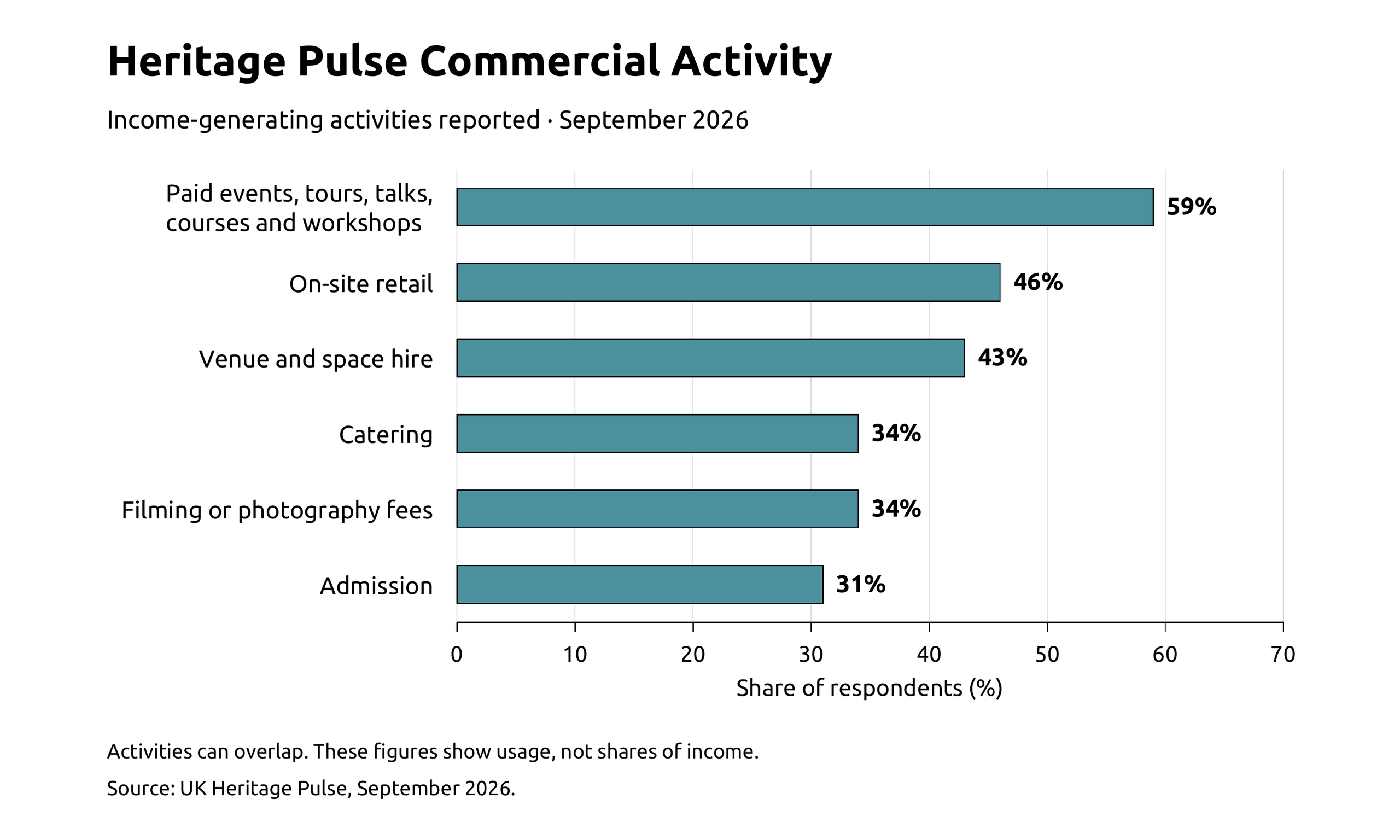
These figures describe the activities organisations undertake, rather than the amount each earns. They nevertheless show how frequently heritage organisations use their spaces and expertise to generate income, alongside more familiar visitor spending in shops and cafés.
Among the 48 respondents who ranked their income sources, admission received 10 first-place rankings, followed by venue and space hire with seven. Paid events and on-site shops each received four first-place rankings, showing that their widespread use does not necessarily make them an organisation’s largest earner.
The financial contribution varies considerably. Of the 38 respondents who estimated the proportion of their income coming from trading, 18 said it accounted for at least half, including 14 who put the figure at 75% or more. At the other end, five reported a contribution below 10%, and one reported none.
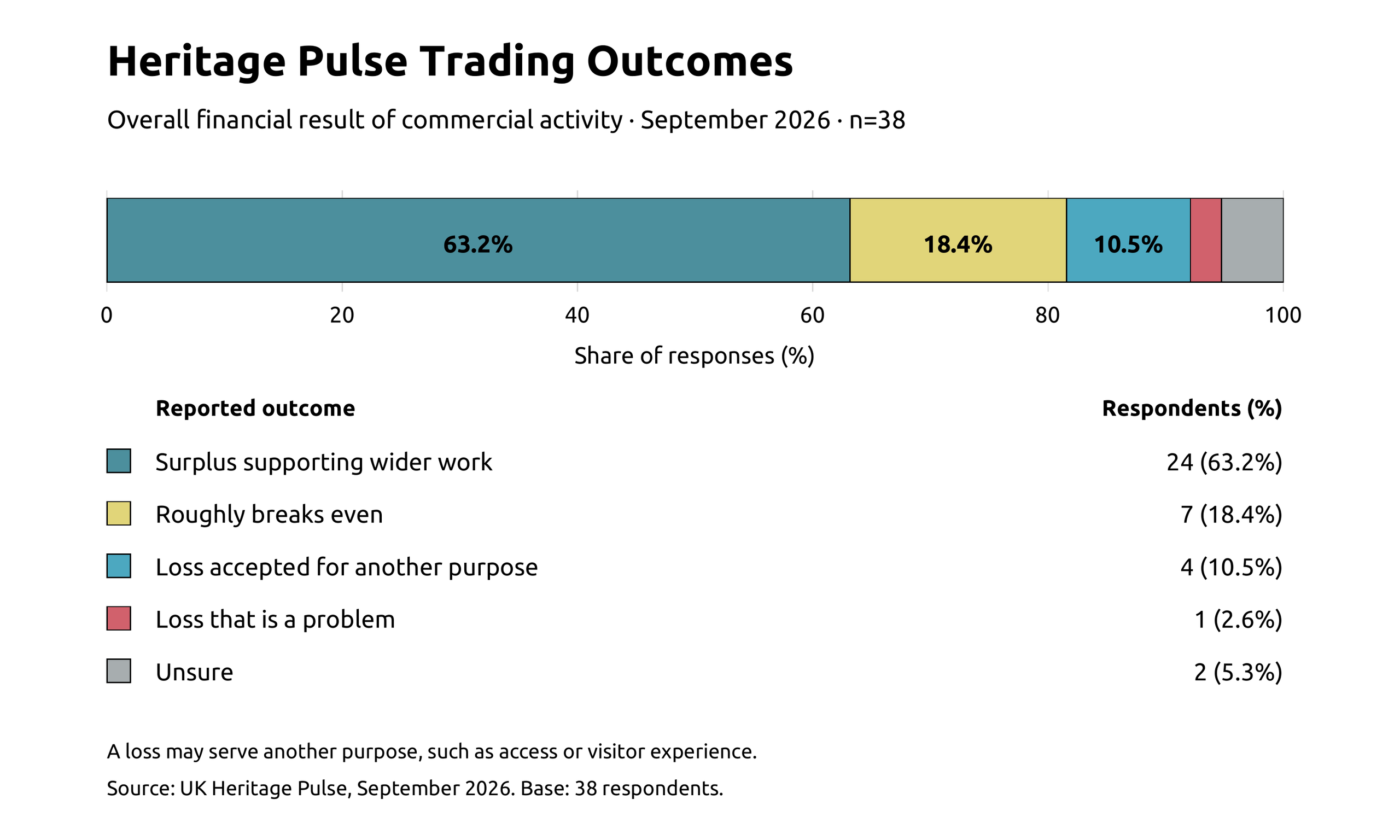
Asked about the overall financial result, 24 of 38 respondents said their commercial activity generated a surplus that supported their wider work. Seven roughly broke even, while four accepted a loss because the activity served another purpose, such as access or visitor experience. One reported a loss that was a problem, and two were unsure.
For some organisations, commercial income therefore makes a substantial contribution to the work beyond the activity earning it. For others, the decision to continue an activity includes benefits that will not appear as a financial surplus.
Strong support for entrepreneurial thinking
Across two separate paired-statement questions, 89% of respondents leaned towards “The sector must embrace entrepreneurial thinking to survive”, while 67% leaned towards “Trading is a core part of how we deliver our mission” (51 and 38 of 57 respondents respectively).
One church described guidebooks, cards and occasional talks as minor fundraising and publicity, with volunteers undertaking all the work. A community organisation explained that membership fees and refreshments supported its regular activity, while particular projects depended on applications to charitable funders.
Plans for growth and innovation
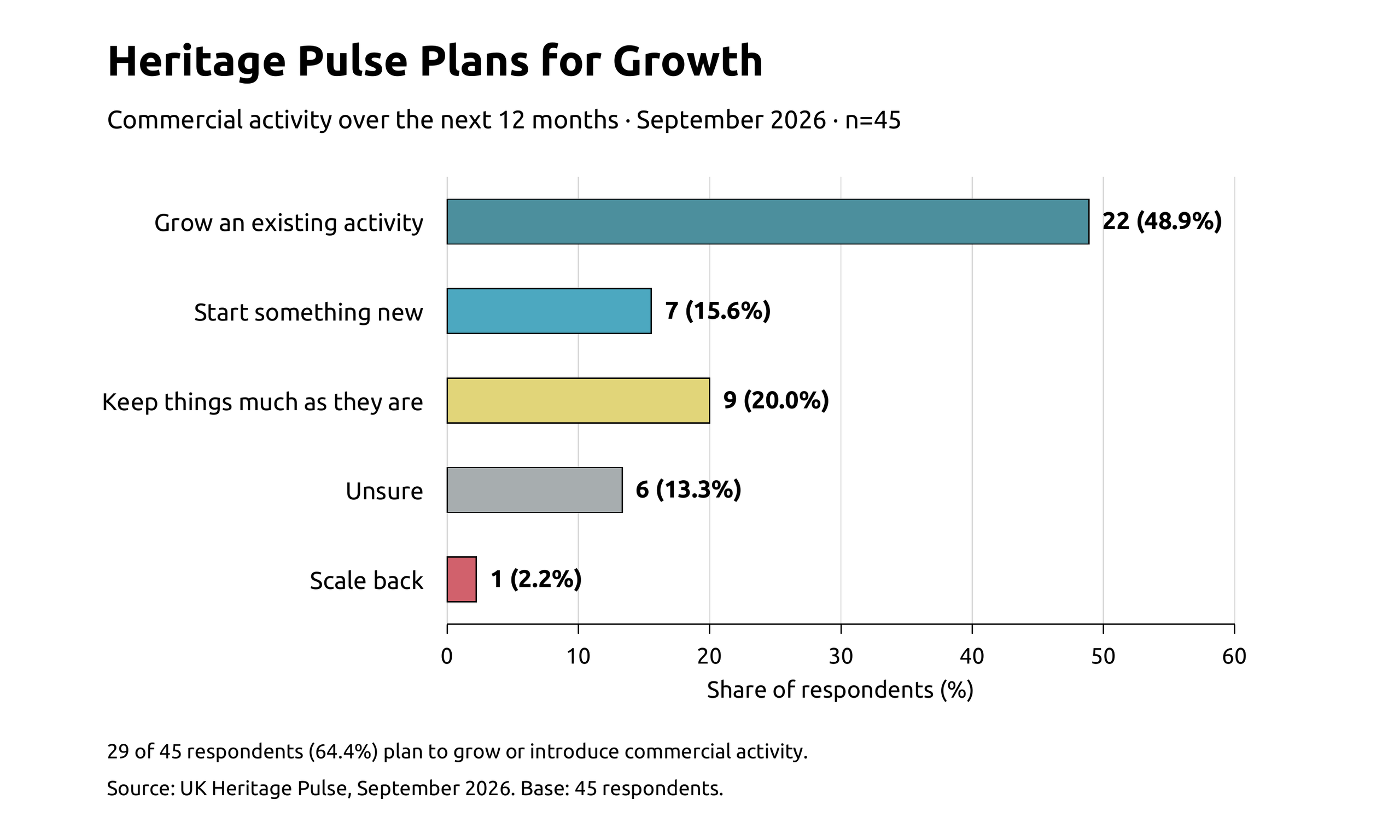
Of the 45 respondents who described their plans for the next 12 months, 22 expected to grow what they already did and seven expected to start something new. Together, that represents 64% planning some form of commercial expansion.
Nine expected to keep things much as they were, six were unsure, and one expected to scale back. Growing an existing activity was therefore the most common intention, accounting for almost half of responses.
The comments describe adjustments within individual income streams. One respondent reported falling retail sales alongside continuing demand for events, attributing the retail decline to the cost of living. Another described fewer weddings and a decision to pursue a smaller number with higher budgets.
Commercial opportunities can also affect public access. One respondent explained that their organisation had become more willing to close its visitor attraction element periodically to accommodate commercial bookings, including weddings and filming. Though commercial bookings assist in overall sustainability, that account is a demonstration of how decisions about income can require organisations to weigh the financial benefit of a booking against other immediate priorities.
Limited capacity and concern about losses
Asked to position their organisation’s approach to risk on a four-point scale between two opposing statements, 30 of 57 respondents (53%) leaned towards “We take risks on new ventures and accept that some will fail”, while 27 (47%) leaned towards “We can’t afford to lose money on experiments”.
Among respondents from organisations with no paid employees, eight of 11 leaned towards being unable to afford such losses, compared with 18 of 41 among those with paid staff. These are small groups, but the difference warrants attention alongside the comments about volunteer capacity.
One respondent described the constraint directly:
“Our income generation remains steady. One of the biggest barriers we have to growing is the small size of the organisation. Not having the capacity to develop the business side holds us back. Balancing all areas of work is also problematic.”
A volunteer-run museum similarly reported lacking the expertise or space to concentrate on increasing its commercial activity. A group organising events in a public park described rising costs for insurance and equipment hire, together with too few volunteers to staff the events themselves.
For these respondents, expanding trading would require additional capacity or investment before it could generate a greater return. The willingness to develop commercial activity has to sit alongside an assessment of the time available and the consequences of a loss.
Keeping a distinctive heritage offer
Asked about the character of their commercial offer, 77% leaned towards making it distinctly unique to their organisation, even where that cost more to deliver (43 of 56). This suggests considerable support for preserving an organisation’s particular character when developing what it sells.
Commercial skills also received substantial support: 64% leaned towards the statement that their people needed commercial skills as much as heritage skills (36 of 56). Read alongside the comments about limited expertise, this identifies a practical area for support, especially where a small team already covers several roles.
One respondent’s request was explicit:
“More funding opportunities to kickstart trading initiatives would be very useful.”
Organisations already heavily reliant on trading are particularly likely to be planning further growth: 11 of the 14 respondents receiving at least 75% of their income from commercial activity expect to grow what they already do. For these organisations, developing that income has a direct bearing on how they fund their wider work.
Commercial development requires time and investment before additional income arrives, adding to the demands on teams already responsible for caring for heritage. Respondents suggest that funding to establish or test an activity, accompanied by access to commercial expertise, could help organisations assess opportunities and make informed decisions about what they can afford to undertake. Such support would also need to recognise the value respondents place on retaining a commercial offer rooted in the particular heritage they care for.
Signposts: Resources for commercial development
Explore practical guidance, learn from other organisations and find support for developing commercial activity.
Explore and plan
- AIM Fragile to Flourishing
Test new ideas using an enterprise business case canvas, financial scenario tools and organisational diagnostics. Includes museum case studies. Free downloads. - AIM Museum 101 Success Guides
Practical guidance on retail, cafés, venue hire, admissions pricing and business planning. Free guides. - Power to Change Community Business Success Guides
Guides to cafés, room hire, retail and lettings for community organisations developing trading income. Free downloads, published in 2022; refresh financial assumptions.
See examples
- AIM Income generation ideas
Glencoe Folk Museum, Clifton Suspension Bridge Trust and Woodchester Mansion share examples of distinctive products, paid tours and heritage experiences. Free case studies. - SSE How we use our trading to fund our community outreach
Arts Groupie explains how paid heritage walking tours support free community workshops. Free article.
Get help
- Cultural Enterprises Academy
Develop commercial skills in retail, catering, venue hire and income strategy. Included in organisational membership; non-members can purchase individual courses. - Heritage Network Expert Panel
Specialist advice, short-term mentoring and organisational health checks for community heritage organisations. Paying members; support follows an assessment of need. - Architectural Heritage Fund support and Funding Finder
Advice and project-development funding for bringing historic buildings into sustainable use. Eligibility varies by UK nation and scheme; loans are repayable. - Investing in Volunteers Essentials
Review volunteer practice and create an action plan to support organisational capacity. Free, with sign-up; UK-wide.
UK Heritage Pulse is not responsible for, nor does it endorse, content on other sites.
Pulse Monitor
September’s Pulse Monitor recorded high confidence in organisational survival, at 8.8 out of 10, alongside lower scores for adapting to financial pressures and recruiting staff or volunteers. Compared with June, all eight average scores were lower, including stress, where a lower score is favourable.
The charts retain the historical results shown in previous releases and add the May, June and September survey rounds. Each round includes a different mix of respondents, so changes in the averages describe the people who answered that survey and do not establish a change across the whole sector.
Organisational resilience
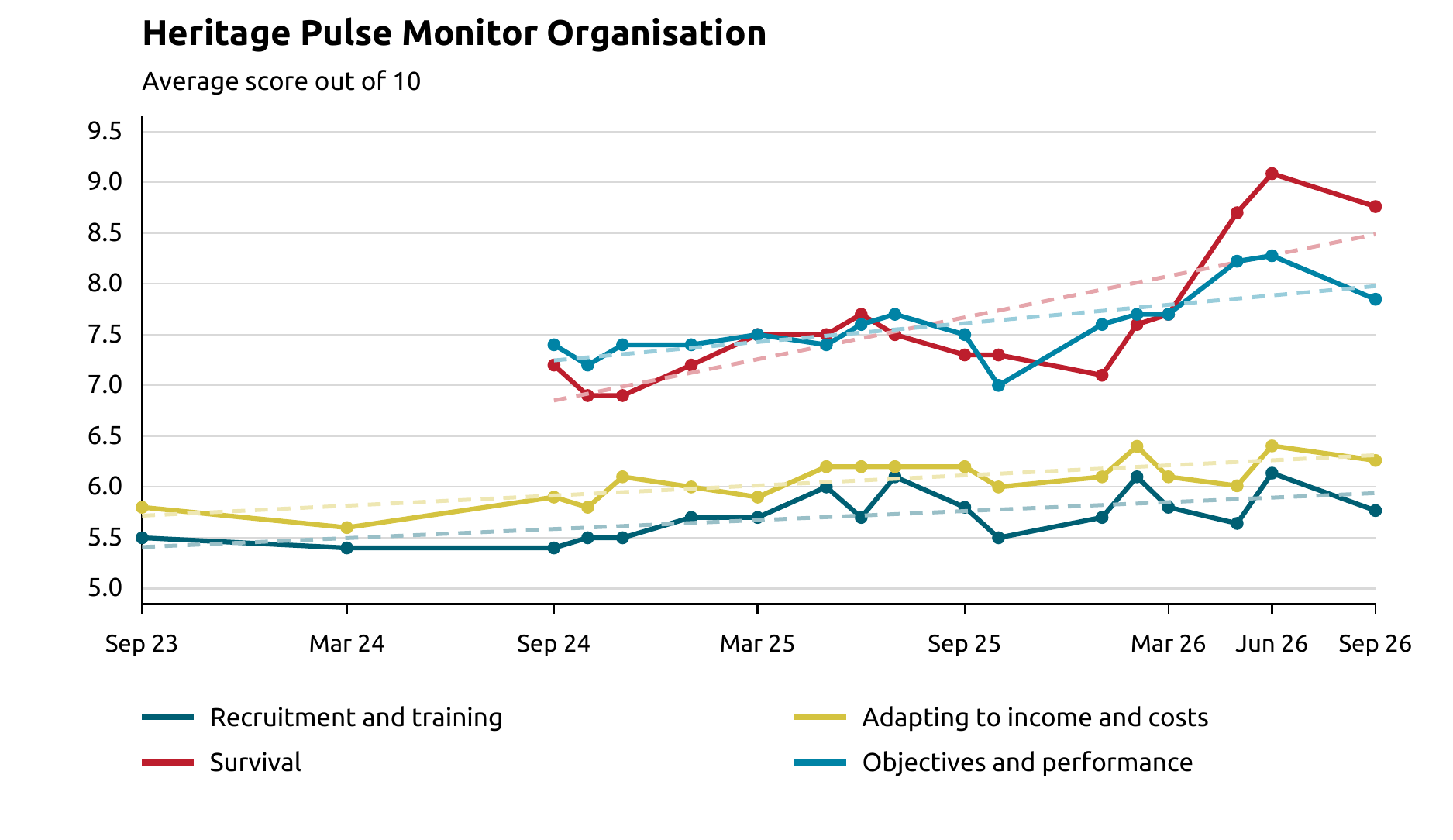
Confidence in surviving the next 12 months averaged 8.8 in September, compared with 9.1 in June and 8.7 in May. Understanding objectives and performance averaged 7.8, down from 8.3 in June and 8.2 in May. The September averages for adapting to reduced income or increasing costs (6.3) and recruiting and training staff or volunteers (5.8) were also below June’s scores of 6.4 and 6.1 respectively.
Organisational response distributions
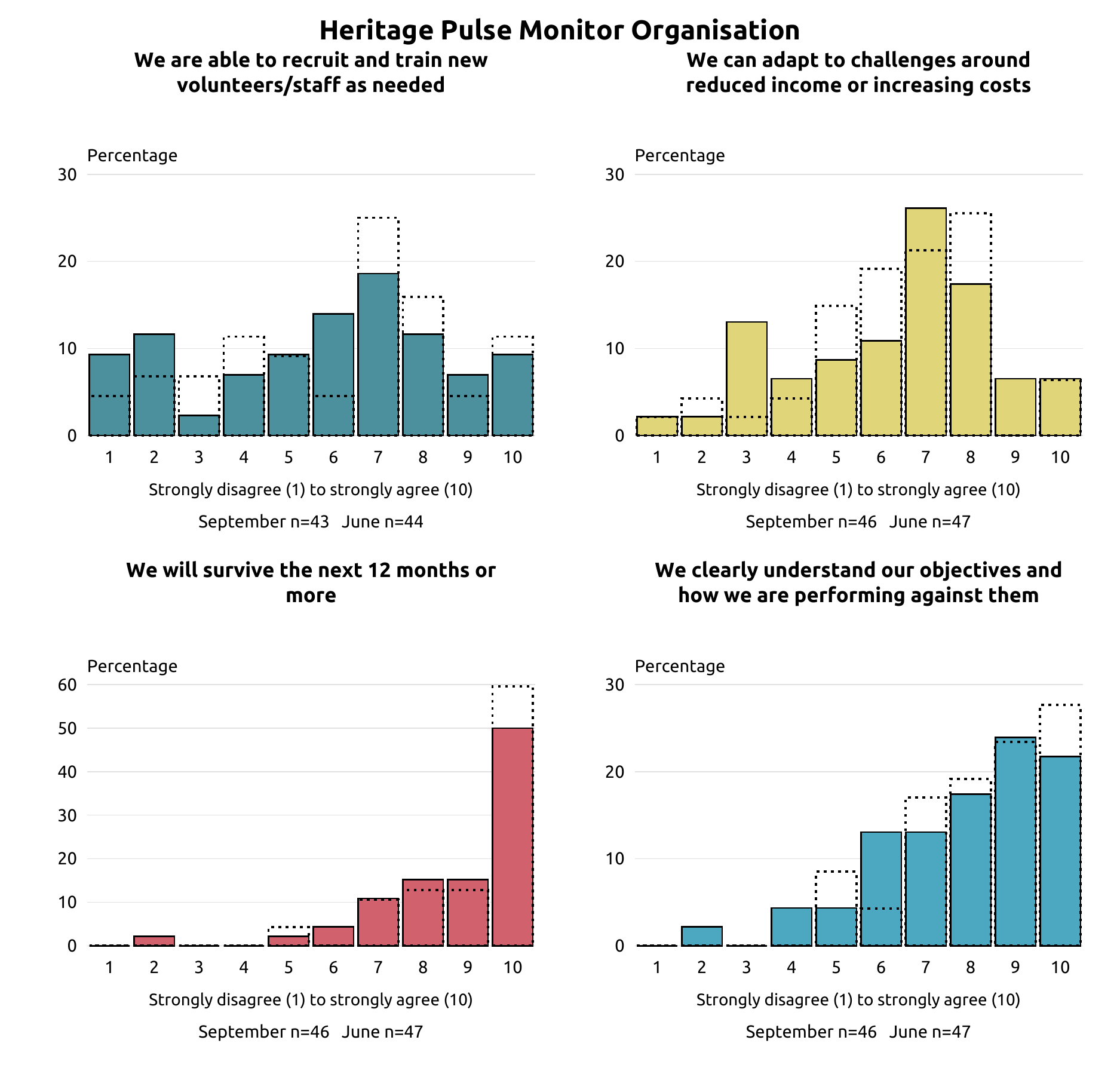
Half of respondents gave the maximum score of 10 for confidence in survival (23 of 46). Recruitment and training answers were more widely spread, with nine of 43 respondents scoring their position at 1 or 2.
Care for heritage and community value
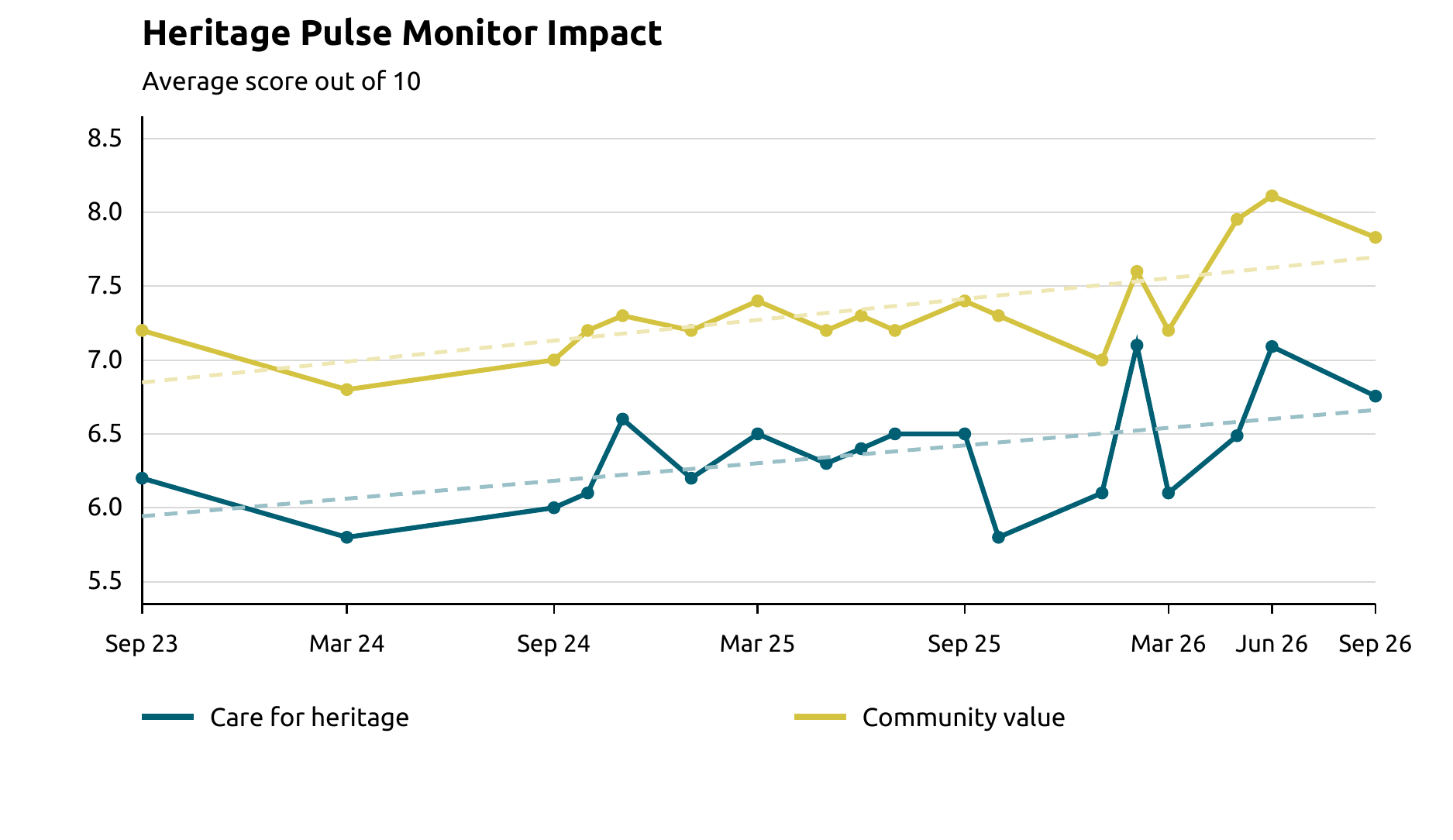
Confidence in adequately caring for heritage or collections averaged 6.8 in September, compared with 7.1 in June and 6.5 in May. The average score for feeling valued by the community was 7.8, compared with 8.1 in June and 8.0 in May.
Stress and intention to stay
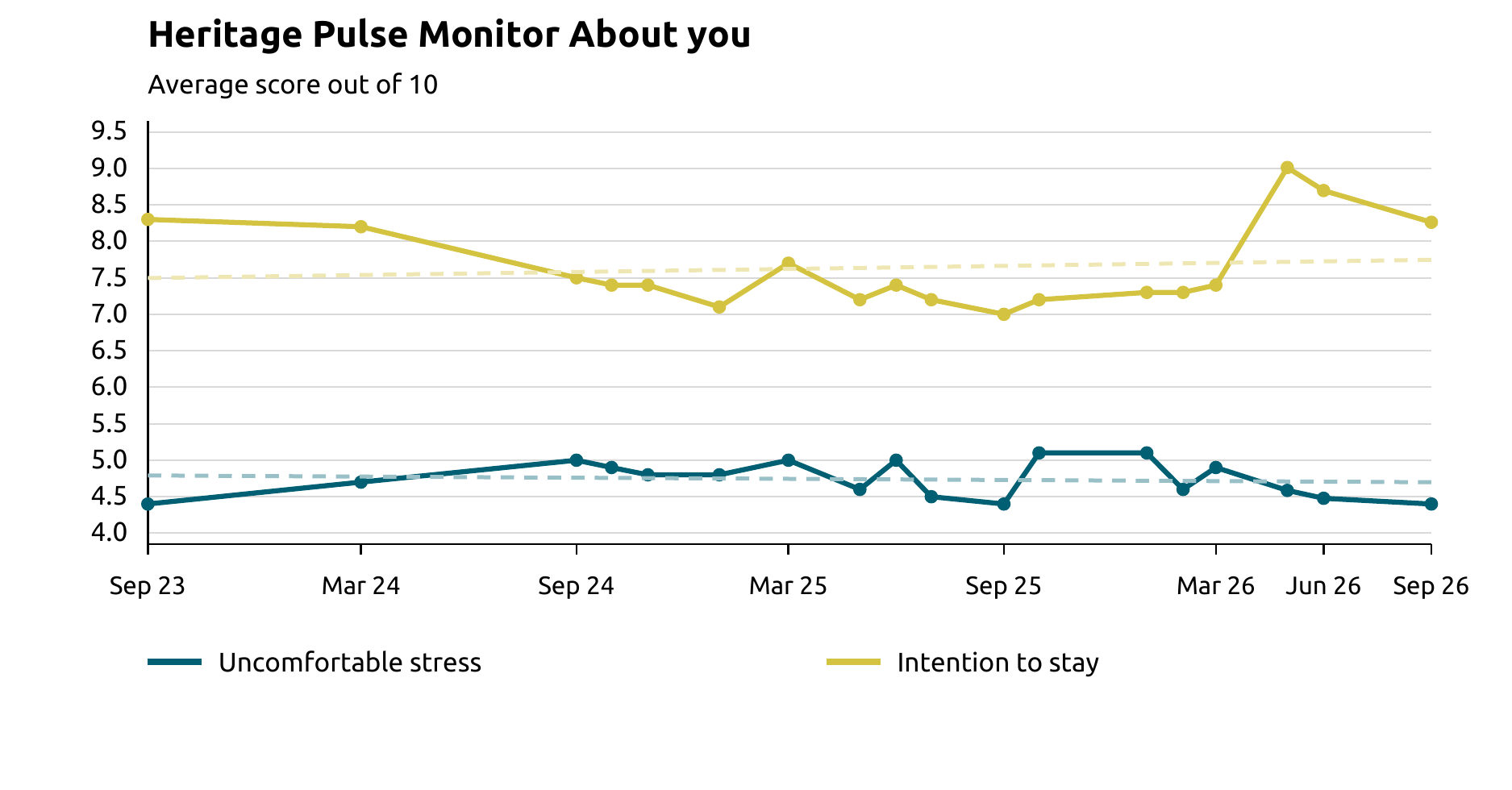
Reported uncomfortable stress averaged 4.4 in September, compared with 4.5 in June and 4.6 in May, with lower scores indicating a more favourable response. Intention to remain at the current organisation averaged 8.3, compared with 8.7 in June and 9.0 in May.
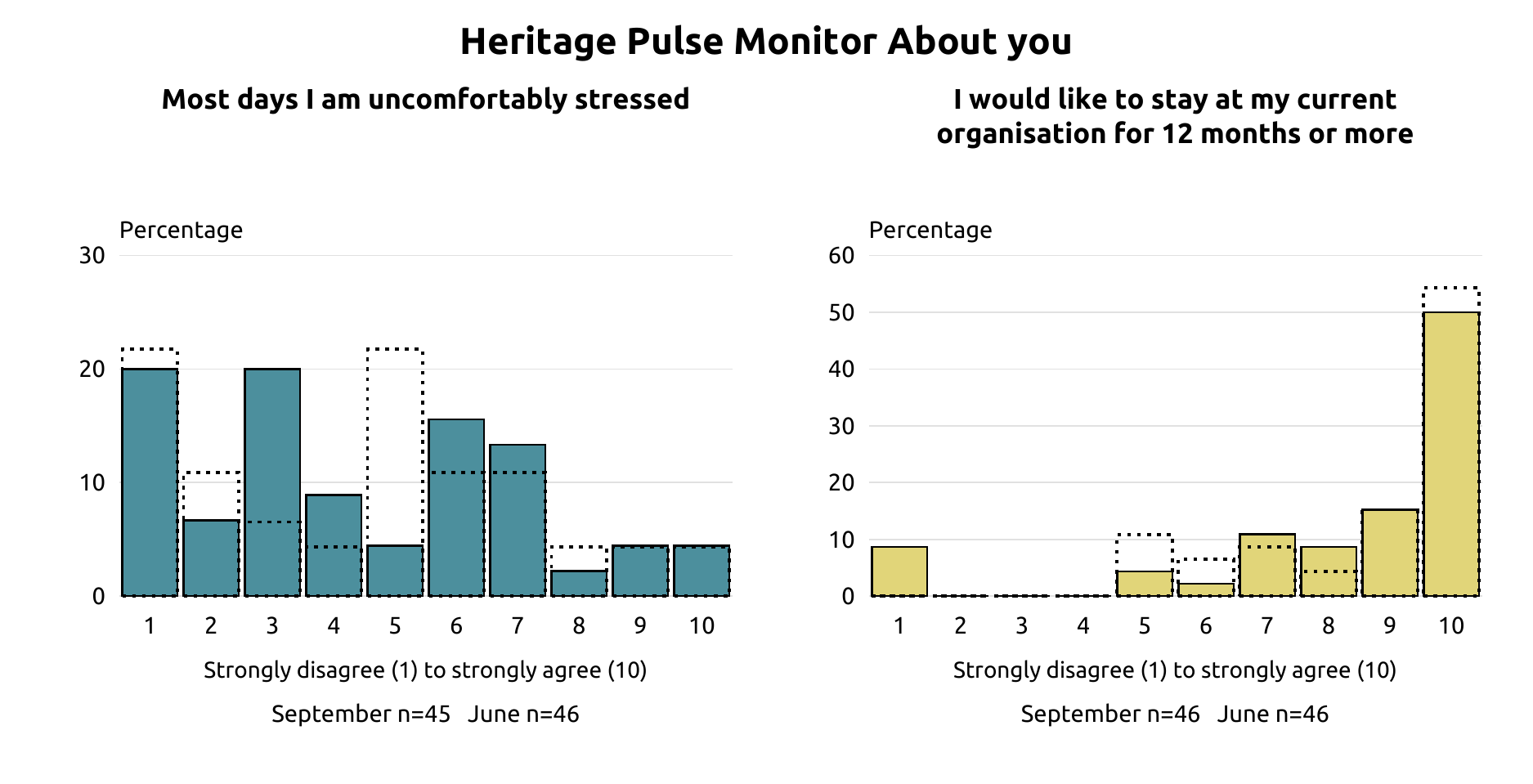
Photo by Antoine Schibler on Unsplash