
The latest UK Heritage Pulse survey reveals a growing confidence in artificial intelligence (AI) across the UK heritage sector. While challenges remain – particularly around training and ethics – more organisations are now seeing AI as a practical tool rather than a distant concept.
AI seen as more of an opportunity than a threat
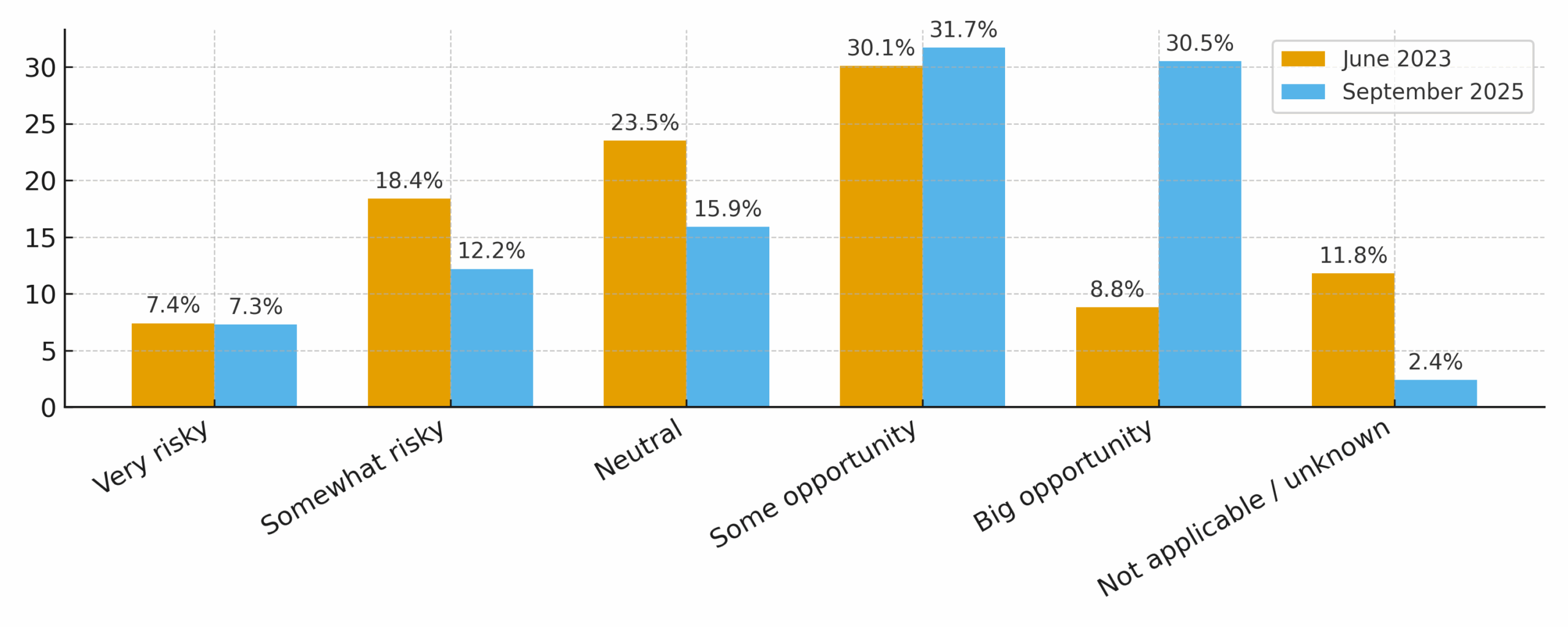
More than 60% of respondents now believe AI offers more opportunities than risks for their organisations – a jump of 20 percentage points since 2023. The number of those viewing AI as “very risky” has held steady at just 7%, while far fewer now say it’s “not applicable” to their work.
Helping rather than replacing
When asked where AI is most valuable, respondents highlighted administrative and back-office tasks – like automating routine processes, speeding up admin, and assisting with transcription. In contrast, AI was seen as least valuable in visitor-facing roles, such as interactive interpretation, chatbots, or digital reconstructions.
Half of organisations are experimenting
Right now, half of respondents say they’re still exploring AI or not using it yet. Among those already experimenting, AI is most often applied to internal efficiency and research or data analysis – for instance, image recognition and collections management.
Heritage-specific training remains a concern
Despite optimism, four in five heritage professionals say they lack access to adequate training to make the most of AI. Many express confidence in evaluating AI-generated outputs, but concerns persist about accuracy, ethics, and long-term sustainability. Only a quarter foresee resistance to the use of AI from within their organisations.
Download the full report
Pulse Monitor: Resilience, Retention, and Rising Confidence
Beyond AI, Heritage Pulse continues to track the sector’s wellbeing and resilience.
Stress levels down, but intention to stay decreasing
Reported stress among panel members has fallen to 4.4 out of 10, the lowest in two years. However, the proportion intending to stay with their current organisation for another year has dropped to 7 out of 10, continuing a two-year decline. Those in smaller organisations (turnover under £500K) are less likely to want to stay.
Organisational confidence
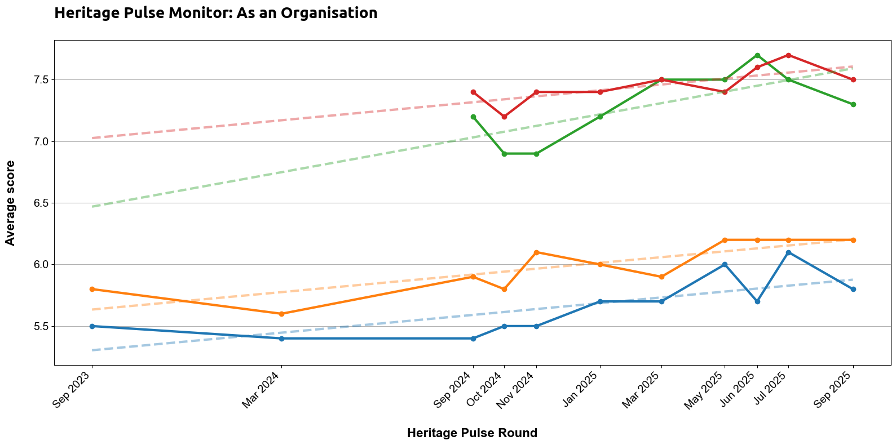
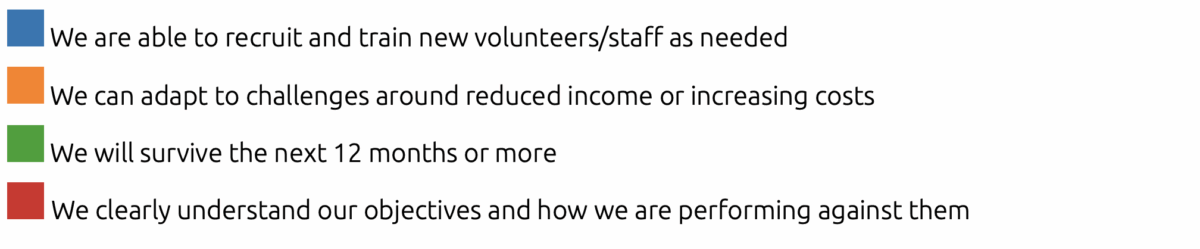
Confidence in organisations’ ability to recruit and train new volunteers / staff as needed remains on an upward trajectory, though confidence in adapting to reduced income or increasing costs has remained flat over the past five months. Respondents’ understanding of their objectives is strong, with over 80% agreeing they know what success looks like.
Community value remains high
Perceptions of how communities value heritage are holding steady at 7.4 out of 10, matching the highest levels seen earlier this year. Respondents also report growing confidence in their ability to care for collections and heritage assets.
Download the full report
Photo by Emilipothèse on Unsplash


I recently asked AI (Gemini) to decipher some memorial writing (to me indecipherable) from a photo of a brass plaque in our local church. Gemini worked out it was Early Modern English, gave a transcript, a modern english translation and some summary interpretation, as far as I can tell based on just reading it through, all brilliant.
So I take the point that we should check AI’s output and in other contexts I have found errors in AI’s output. But in the case of an Early Modern English text, how could I check the output? If I search for Early Modern English translators, they are all AI! I am simply not going to spend the time and money trying to find a human expert translator.
In this case, AI has opened up the possibility of some heritage appreciation that in practice simply would not be there any other way.